
National Emergency Tarp Services
Who Requests Emergency Tarp Service?
- Insurance carriers managing catastrophic storm damage events across multiple properties simultaneously
- Independent adjusters who need a reliable, same-day vendor to deploy protection before a full inspection can be completed
- Claims managers at regional and national carriers who require consistent documentation standards across their vendor network
Adjuster-initiated requests are accepted 24/7 through our inspection portal or by phone. Our nationwide deployment network means no claim is too remote or too last-minute.
What the Service Covers and What It Does Not
Emergency tarping is a temporary protective measure, not a repair. Its job is to limit further loss while the claim runs its course. Being precise about that boundary protects the carrier, the policyholder and the file.
- Installs temporary protective covering over the opening
- Works to limit further water intrusion while the claim proceeds
- Documents the damage found on arrival
- Documents the mitigation work performed and the area covered
- Reports back to the carrier or adjuster who placed the assignment
- Permanent or structural repair of any kind
- Reconstruction, replacement or restoration work
- Repair estimates or cost projections
- Determining coverage or the outcome of the claim
- Acting for the policyholder or contracting with them directly
Temporary means temporary. A tarp buys time; it does not resolve the loss. The permanent repair is arranged separately through the claim. Keeping mitigation and repair in separate hands is also what keeps Patriot’s documentation neutral. We have no stake in the repair that follows.
The Emergency Tarp Process
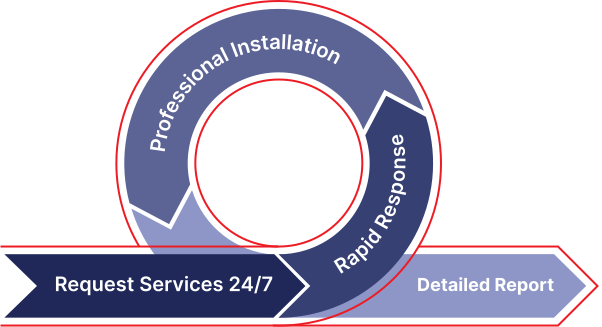
Step 1. Request Services 24/7
Step 2. Rapid Deployment
Step 3. Professional Installation
Step 4. Insurance-Ready Reporting
How the Assignment Is Coordinated
Emergency work is carrier-initiated. The assignment comes from the adjuster or the carrier, and the file comes back to them. The policyholder is never left arranging it themselves.
The adjuster or carrier requests mitigation, with the property details and whatever is already known about the loss.
Timing, access and the extent of the opening are agreed before anyone is dispatched. Availability is confirmed when the assignment is placed.
The damage is photographed as found, before any covering goes on, so the file records the pre-mitigation condition.
Protective covering is fitted to the opening, with the method suited to the roof and what is safely reachable.
The completed mitigation is photographed and recorded: what was covered, how, and the area protected.
Documentation moves through review and is delivered to the adjuster who placed the assignment.
What gets documented
The opening and surrounding damage photographed before mitigation begins, establishing the pre-existing state.
What was installed, where, and the extent of the area covered, photographed on completion.
Damage recorded by location and type, giving the adjuster a first read on the loss alongside the mitigation record.
Program photo requirements and question sets built into the field workflow and captured on site.
Scope is set by the assignment. What can be covered, and how, depends on the roof, the extent of the opening, the conditions on the day and what is safely reachable. Some openings cannot be safely tarped, and Patriot will say so rather than attempt it.
Need Mitigation and an Inspection on the Same Property?
Most properties that need tarping also need documenting, and both are usually better placed together than separately. Talk it through with our team, or explore what a full carrier partnership would look like.
What Makes Patriot Claims Different?
We are a neutral third-party vendor with no financial interest in the repair scope. Our inspectors do not perform permanent repairs, provide repair estimates, or recommend specific contractors. That independence makes our documentation more credible to carriers and adjusters, and more defensible if a claim is ever disputed.
Additionally:
- HAAG Certified inspectors: our technicians meet the industry standard for damage assessment credibility
- 24/7 availability: not just business hours; response is available every day of the year
- Carrier-standard reporting: deliverables are formatted to meet the requirements of major carriers, not just a photo and an invoice
- Nationwide coverage: a single vendor relationship for multi-region storm events
- No repair conflict: Patriot Claims does not repair roofs or provide cost estimates
Choosing Between Patriot’s Field Services
Mitigation is usually the first step, not the only one. Most properties that need tarping also need inspecting.
| What the claim needs | The service that fits |
|---|---|
| The property is open and needs protecting now | Emergency Tarp (this service) |
| The adjuster does not need to attend the inspection | Direct Inspect |
| The adjuster is attending and needs safe roof access | Ladder Assist |
| The adjuster wants to take part without travelling | Virtual Inspect |
| Sudden weather activity or catastrophe volume | CAT & Surge Support |
After an event, mitigation and inspection are often placed together so the property is protected and the loss documented without a second mobilisation. Talk to our team about how that is set up for your program.
Frequently Asked Questions
What types of damage require emergency tarping?
Does Patriot Claims provide repair estimates alongside tarping?
How quickly can a tarp crew be deployed?
Who receives the damage report after tarping?
Does insurance typically cover emergency tarp services?
When storm damage can’t wait, neither can protection. Contact Patriot Claims to request emergency tarp service, available nationwide, 24 hours a day.
Interested in adding Emergency Tarp Service to your carrier program?
Partner With PatriotTell us where you need field capacity and our team will follow up.